Regjistrohuni për dërgesë falas nga 35 €

Çfarë është Bisfenoli A (BPA)?
Pse MAM ofron produkte pa BPA?
Si pastrohen shishet MAM për foshnja?
Shishet MAM mund të çmontohen lehtësisht për të mundësuar pastrim sa më të thjeshtë dhe të plotë. Çdo pjesë mund të shpëlahet veçmas me ujë dhe një detergjent të butë.
Të gjitha pjesët mund të sterilizohen për të siguruar higjienë maksimale. Sterilizimi para çdo përdorimi është veçanërisht i rëndësishëm për të porsalindurit.
Nga cila moshë nuk është më i nevojshëm sterilizimi i shisheve?
The body’s defences are already very well developed in a baby who is six months old. At this age, all you need to do is sterilise the bottle and the teat occasionally. Sistemi imunitar i foshnjave zhvillohet dhe forcohet gradualisht. Sipas informacionit të faqes origjinale, pas moshës gjashtëmujore, sterilizimi i shishes dhe i biberonit mund të bëhet herë pas here.
Nëse foshnja është e sëmurë, rekomandohet sterilizimi i përditshëm.
Si funksionon vetësterilizimi i shishes MAM Easy Start™ Anti-Colic?
Vetësterilizimi Funksioni i vetësterilizimit të shishes MAM Easy Start™ është dëshmuar efektiv në eliminimin e mikrobeve dhe baktereve të zakonshme shtëpiake. Kjo metodë është e sigurt dhe e mjaftueshme kur përdoret sipas udhëzimeve. Për rezultate sa më të mira, ndiqni me kujdes të gjitha udhëzimet dhe pastroni plotësisht çdo pjesë të shishes përpara sterilizimit. Pas pastrimit, vendosni pjesët sipas renditjes: bazën me valvulën e silikonit, biberonin me unazën, trupin e shishes dhe kapakun mbrojtës.
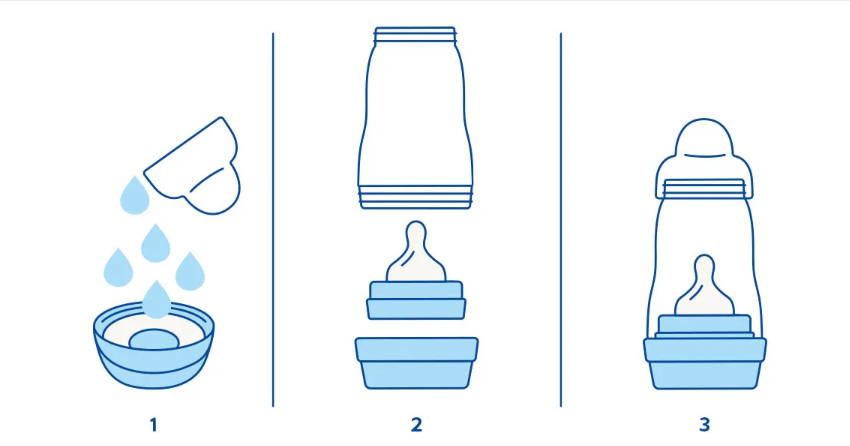
1Matni 20 ml ujë të ftohtë duke përdorur kapakun e shishes. Hidhni ujin në bazën e shishes, ku ndodhet valvula e silikonit.
2Vendosni unazën me biberonin në bazën e shishes dhe më pas trupin e shishes sipër saj. Shtrëngojeni vetëm lehtë, jo plotësisht, për të shmangur derdhjen e ujit të nxehtë gjatë nxjerrjes nga mikrovala. DO NOT SCREW DOWN FULLY.
3Vendosni unazën me biberonin në bazë dhe trupin e shishes sipër. Shtrëngojeni vetëm pak, jo plotësisht.

Pas vetësterilizimit, lëreni shishen të ftohet përpara se ta nxirrni nga mikrovala.
Recommended cooling time at least 10 minutes with opened microwave door. Be careful to hold the base and keep the bottle straight when removing from the microwave to avoid spilling any left over hot water.
After the process is complete, the Easy Start bottle remains disinfected for up to 48 hours after self-sterilising in the microwave, provided that it remains assembled as shown in Step 3.
For immediate usage: Pour away the leftover water from the base. Allow bottle parts to dry.
Always store bottle assembled.
IMPORTANT FACTS - For correct microwave sterilisation
Follow the instructions in the user manual of your microwave or multifunctional device.
Ensure that all parts of the self-sterilising bottle and microwave (including waveguide cover and turntable) are COMPLETELY clean and free from dirt, food residue, fat or oil splashes. If not this could lead to the product melting, the microwave sparking or the waveguide-cover burning!
The Easy Start Anti-Colic bottle should only be placed on solid and flat surfaces.
Do not put the Easy Start Anti-Colic bottle in the center of the turntable as this could result in an uneven heat distribution.
Do not leave your microwave unattended during the sterilising process.
Never place the device in the microwave without water.
Stop the microwaving process immediately if all the water has been vaporised!
Filling the base with too much or not enough water can damage the bottle.
Always set the microwave to the correct power and time.
If using a combination microwave oven, ensure that the Easy Start Anti-Colic bottle is not exposed to the heat of the grill because this will damage it.
TAKE CARE when handling recently disinfected items: they may still be hot.
Wash hands before touching disinfected items.
Be careful to hold the base and keep holding the bottle up straight when removing from the microwave to avoid spilling any leftover hot water.
Do not wash the Easy Start Anti-Colic bottle after disinfection.
Do not touch the teat after disinfection. Handle teat by using the screw ring.
Çfarë duhet të kem parasysh gjatë përgatitjes dhe ngrohjes së ushqimit në shishe?
Before the bottle is placed in the water bath or the bottle warmer, the sealing cap is always removed. The contents of the bottle must not boil – so do not pour any boiling liquids into it!
Before feeding begins, the bottle should be dried using a clean cloth
A mund të ngrohen shishet MAM në mikrovalë?
Yes. Simply remove the cap, ring and teat and warm up the MAM bottle in the microwave. After heating, stir around so that the heat is evenly distributed. Before baby begins to eat any food, check the temperature and then baby can begin eating.
Sa shpesh duhet të ndërrohet biberoni i shishes?
For hygiene reasons, the nipples should be replaced at regular intervals. Simply check the nipple each time you are about to use the bottle – especially when baby already has teeth – and replace it when the first signs of damage or weak points become apparent.
A janë shishet MAM të sigurta nga rrjedhja gjatë transportit?
Yes, because the innovative protective cap ensures that the liquid remains in the bottle. This means there is no need for any small sealing disc: Simply place the protective cap on the bottle and then you can transport it safely.
A janë shishet MAM rezistente ndaj thyerjes?
Yes, all parts in the MAM bottles are shatterproof, except the Glass bottle as glass may break.
Kur duhet të kalojë foshnja nga shishja te gota?
Four-month-old babies love drinking from a cup. The MAM Cup range provides them with the ideal support here. This will ensure that baby makes the perfect transition from breastfeeding or bottle feeding to independent drinking.
A përmbajnë produktet MAM substanca plastifikuese?
No. MAM products do not contain any plasticizers.
MAM only ever uses materials which satisfy the highest demands and safety standards. This means that MAM products guarantee that babies enjoy the best start in life.
Si pastrohen biberonët qetësues?
Before first use, and at regular intervals thereafter, boil the pacifier in water for up to five minutes.
Please avoid leaving the pacifier in the sterilising solution for longer than the time recommended. Sometimes water may enter the inside of the nipple, this is because of a ventilation systems that exists in the nipple.
When the baby closes down on the nipple, the air from inside the nipple is pushed out through the ventilation system thereby flattening the nipple and adapting to the baby´s individual oral cavity. So, the ventilation hole is needed in order to allow for proper development of your baby's jaw and mouth.